A bit of ‘No’ makes a better ‘Yes’

Saying 'Yes' means we are agreeing to something.

We say 'Yes' many times a day. What are some of the things you say 'Yes' to on a typical day? Note them down.

We say 'Yes' for a variety of reasons:

  • It’s part of our job

  • We can add value

  • Moving towards goals and objectives

  • Opportunity to do something we enjoy

  • Obligation

  • Feeling pressured

  • No alternatives

  • Repercussions if I say “No”

'Yes' implies a commitment. Each commitment we make occupies time and energetic space. Even if we will never deliver, it occupies time and thought. Sometimes we add guilt or anxiety as well. Consider the cost of that commitment (especially if delivery will be difficult) as well as the cost/benefit of saying 'Yes'. Sometimes ‘No’ would be a better response:

  • If we say ‘No’ sometimes, it makes our 'Yes' more valuable.

  • It makes it more likely that when we do say 'Yes', we will deliver.

  • We avoid commitments that we are not willing to keep

Are there times you said 'Yes', but should have said 'No’? What was the cost/impact? Should you be saying ‘No’ more often? What would it take to do that?

Clarity is often missing in our agreements. The clearer you can be about what you are saying 'Yes' (or no) to, the higher the quality of your 'Yes'. Eg. I’ll get back to you soon is less clear than I’ll get back to you by COB. Clear agreements set clear expectations and are easier to deliver and/or manage.

Clarity = tangible agreements

Have you ever said 'Yes' when timing, quality, scope, responsibility, resources (or other details} were unclear? What impact does lack of clarity have on you, your team and others?

For this week, focus on improving the quality of your ‘'Yes'’. When asking others for a ‘'Yes'’, be clearer about what you are asking.

Expedient?

How much pressure are you under to get things done?

Many leaders are experiencing increasing transactional cadence. The rate that things pop into the “to-do’ list is intense. It has us asking ourselves what the most expedient way to deal with each item is. I reckon it’s the wrong question. The quickest way to a result sometimes creates second or third order consequences that consume more time, energy and resources than a little more initial effort might have.

In my front yard right now there’s a large messy hole. The team that installed soak wells and paving did a great job. It looked awesome. But through winter there’s been issues with drainage. Today they dug part of it up to find the problem. A quick compaction job to finish the original job, rather than return another day, left a hollow air space under a pipe. The pipe slumped into the hole and no longer ran freely. It will be a full day to fix, and a fair bit of mess to clean up afterwards.

Some of the leaders I work with are either doing similar, or people in their teams are.

Sending a text rather than meeting about a critical tweak got things moving immediately, but the team is now redoing a heap of work because it was misunderstood.

Assuming someone had been included in a major project briefing, rather than directly checking now has a team buried in contentious stakeholder management, because residents were not informed of a major project nearby.

A customer issue has escalated to a major complaint and standoff after a rushed approach to finding out what the real issue was.

A colleague's motivation has dropped because she wasn’t included in the celebration of a piece of work she majorly contributed too.

These are all examples of time, energy and resource waste because something was done in what appeared to be the expedient way, only to cause more consequences. Most of them could have been avoided with a bit more though before rushing to the desired end point.

Sometimes we have to slow down to go faster. It’s a lesson I find myself learning more often than I’d like. How about you? Where could you slow down to go faster?

The View from Here

How clear is the strategic view in your organisation? Most of the leaders I am working with are experiencing 3 factors clouding the view:

  • Staff shortages - For many this means time off strategy and on tools to keep up. It means employing people you might not employ in different times. It means pressure on induction and training processes as people try to get staff up and running in the shortest possible time. It often means frustration as the combination also makes for low engagement and lack of clarity = do overs, or new people leaving before they are even up to speed.

  • Fatigue - the cadence has been high for ages. To-do lists grow so fast you know some items will die there, never seeing the light of day. People are worn down.

  • Short horizons - some have got into a habit of reacting to whatever comes up. It started with COVID when Friday’s plan was torn up on Monday because the rules had changed - reactivity was the only choice then. Combined with staff shortages and fatigue it’s leaving many feeling as if they are perpetually chasing their tail.

It all obscures the view. How do you know that your business is delivering on what it promises? Are you experiencing a greater than usual gap between front line efforts and high level strategy and planning?

If you answered yes to either of the above, sing out. I have some solutions that are working well across a number of sectors.

Mark the Boundaries

Image by StockSnap from Pixabay

One of the reasons sporting games work so well is the crystal clear boundaries. Everyone knows what defines the field of play. What’s in and what’s out. How to score. Even when there is technical complexity, the rules are clear, and create the conditions for clear decision making (notwithstanding the perpetual armchair critic who can always clearly see how the ref got it wrong!). These clear constraints are what make games work. 

Lack of clarity creates ambiguity and often the result is uncertainty and/or stress. As a leader, we can contribute to clarity via regular discussion about the boundaries. Unlike a ‘field of play’ where the boundaries are clearly marked, work often has boundaries marked only in our collective understanding. If the collective understanding is fuzzy, so are the boundaries.

A simple framework for the discussion is:

  • IN - what’s clearly ‘in’? Why? What purpose does it serve? How does it help us deliver? When is it important?

  • OUT - What’s clearly ‘out’? Why? How does it detract or distract us from our important work? What are the consequences if we are ‘out of bounds’? How can we stop or reset ‘play’ when we are ‘out’?

  • DISCUSS - Some areas of our work are open to discussion or judgement and creativity. What constitutes ‘good enough’? What’s our appetite for risk? How do we decide when we disagree, and there are sound reasons for each position? How will we innovate if it hasn’t been done before? What do we do when we are caught by surprise or disrupted? How should we use our judgement? Discussion in the fuzzy territory between clearly in or out results in greater clarity of the boundaries.

This approach can be applied to specific roles, delegation, projects, decision making process, team norms/expectations, delivery against metrics and more.

Where could you clarify boundaries today?

Goals?

“The biggest casualty of COVID will be goals and plans”. So said Jason Clarke, Mindworker when I interviewed him right back at the beginning of the pandemic.

I reckon he hit the nail on the head. Many of my goals and plans got sidelined, and no doubt yours did too. During that period we all experienced this together, but that kind of disruption happens all the time on a smaller scale.

Factors outside our control make a mockery of our plans. Consider some of these scenarios, any of which could leave your plans in a smoking pile. Some of them might be familiar:

  • War breaks out in your region

  • Interest rates climb, changing your financial reality

  • New technology threatens or removes your job

  • You or someone close to you becomes seriously injured or ill

  • A competitor out-paces you

  • Your entire worldly goods are lost in a natural disaster such as a fire or flood

  • A funding program changes its costing model destroying the margins for your not for profit

  • Your business is unable to source mission critical supplies

  • You cannot find enough staff to run your business

I’m sure you know people who have been impacted by such realities. Maybe you are currently directly experiencing them yourself.

In the face of these kinds of disruption a typically constructed SMART goal may not stand up.

On survival courses we taught 5 priorities for survival. The priorities give clear focus to make a flexible plan that you can adapt to the reality you face.

Some of the sectors I work with find “Areas of Focus” a great way to handle uncertainty.

Regardless of how much duress you are currently under, being clear about your top priorities and key areas of focus is part of creating a psychologically safe environment that withstands disruption.

What are you focussing on in 2023?

If you’d like a conversation about planning for/in uncertainty, I’d love to hear from you.

Bulls and Boardrooms

I stood on the sideline of the auction yards, hoping to buy a bull that (in my opinion) was the finest animal on the lot. It would be a great addition to the farm breeding stock. Two bids later, I stepped back and watched the price climb. Maybe I was right about it being the best bull. It sold for the top price. I eventually secured a lesser bull. I made the decision without supervision and using someone else's money. The farmer I worked for was a master of delegation. He had given me a signed blank cheque and sent me to the annual sale alone. His instructions were simple. “Buy the best bull you can. Don’t spend more than $1500.” When I got back I told him about the best bull, and together we admired the one I had purchased.

Bull

I’ve often thought of him when I lead others and work with leaders. One of the most significant roles of a leader, all the way to the boardroom, is delegation. Despite delegating all the time, there’s often unnecessary friction because we don’t always do it well.

What that farmer did very well was define the task or territory - Best bull possible at or below $1500. My task was epic for my age and experience, but the parameters were crystal clear. I knew precisely what was in and out of my authority that day. He also backed the decision I had made.

When we are delegating, we can reduce friction significantly by clearly discussing what is in and out of the territory. Sometimes there will be grey areas, in which case discuss the triggers to refer back for more information or support.

And get really good at accepting the outcomes of delegated territory. Questioning or criticising decisions and actions makes it much less likely that people will want to act for you next time round.

How and where could you improve your capacity for delegation?

Break Back to Back

Guess what! Back to back virtual meetings cause elevated stress levels. Recent research from Microsoft confirms it, but none of us are surprised. Anyone who has leapt from one “Brady Bunch” screen to another has felt it.

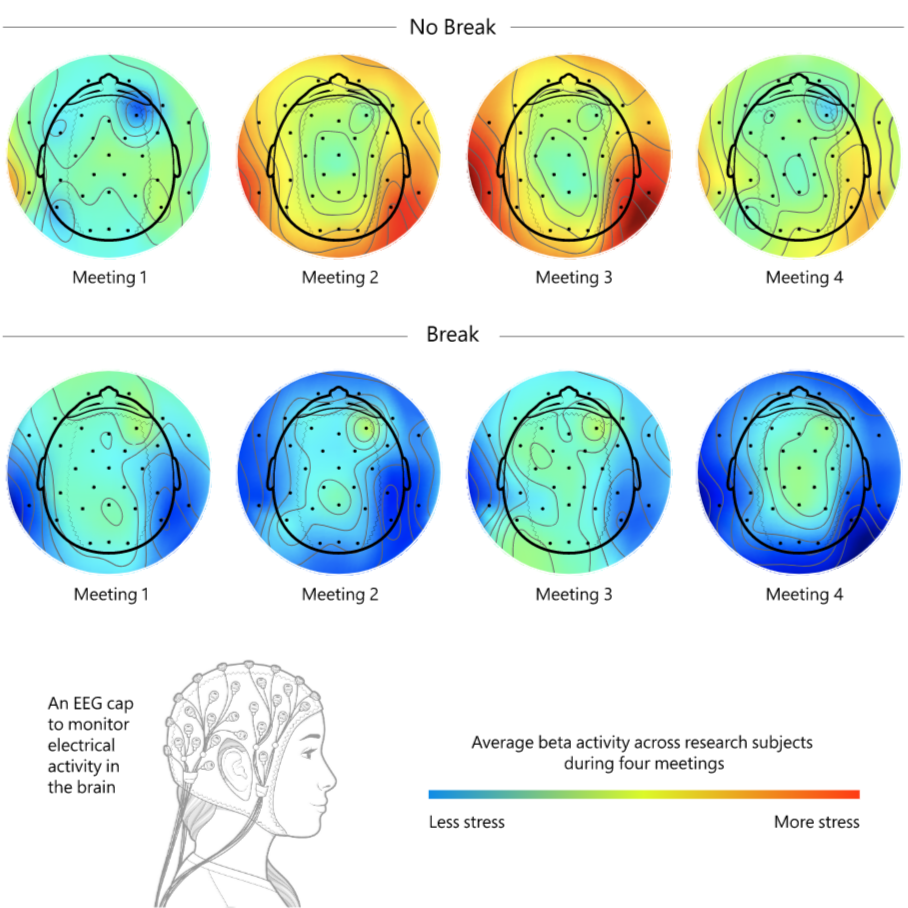
Microsoft scanned the brains of 14 people as they went back-to-back, compared to taking a 5 to 10 minute break between meetings. Back to back = elevated and sustained stress levels (Red/Yellow scan). Short breaks = minimal stress (Blue scan).


And while the research focuses on virtual meetings, I reckon it would hold true for face to face ones as well (although at least there is a short decompression as you move from one to the other.)

Elevated stress smashes our ability to think, decide, solve, communicate, and collaborate. Most of those meetings require one or more of these from us. As a survival instructor, creating ‘task saturation’ was a really easy way to create duress for a team on a survival course. Impose a tight deadline, swamp them with information, ask for clear decisions and plans, hit them with distractions and before long the stress levels are through the roof and mistakes are made. That adds even more pressure, as now the team has to solve problems it has created for itself. Now add conflict (or at least friction/tension) as people get shorter and sharper with each other. Does this sound familiar?

We can do better. And we need to. This stuff has a direct impact on bottom line. In Australia there have also been recent changes to Work Health and Safety that put greater responsibility for workplace mental health and wellbeing on employers. This stuff has a pretty clear cause and effect chain. There are known health consequences of sustained levels of unhealthy stress. Back to Back environments may well end up in similar territory of allowing employees to operate in dangerous environments when fatigued. In a tight recruitment market, being a better place to work will also be a competitive edge. Proactively addressing this problem makes sense on many fronts.

Potential system solutions:

  • Set calendar systems to make meetings 25 min rather than 30, or 50 min rather than 1hr.

  • Set 2 or 3, 15 to 20 minute break blocks per day where none can book anyone for anything.

Potential style solutions:

  • Have some meetings standing up/walking, and outside.

  • Lead by example. Take mini breaks. Encourage others to do the same.

Potential working solutions:

  • Give people greater say in the meetings that they attend, or at least ask ‘why do we need this meeting?’

  • Get clear about what the meeting is for. If it’s not clear, can it.

People are generally experiencing higher than normal levels of fatigue, stress and burnout. “Push Through!” is a valid answer in short burn situations. It doesn’t work in longer burn ones.

Let’s create an environment where we all scan ‘Blue’.

A Killer Checklist

I use and recommend checklists widely as a highly effective Capacity raising tool. A question I often get, especially from busy leaders who are implementing them for the first time is “How do I create a truly effective checklist?”. If you are making one for the first time, brain dump as many things as you can think of in appropriate detail. Then refine using these 4 elements.

  1. Use it - The best checklists are the ones you use. A brilliant one left on the shelf is no use at all.

  2. Storage - I store mine in a separate notebook in OneNote. Each has its own page. This means I can use it on any device and it updates to all of them.

  3. Aide Memoire - the pre takeoff checklist I use is HTMPFFIC. It’s easier to remember that than the separate elements. (More on that checklist later). Is there a way you can make it more memorable?

  4. Evolution - As you use it, notice how effective it is. Does it need evolving? Evolution could be simplified by grouping together or adding more detail. When I was instructing survival I simplified by adding “Survival Belt” to my list, rather than the 50+ individual items in the belt. When I pack for a presentation I separate Computer, Power Cables, and Adaptors because each is mission critical and they are stored in different places. I also evolve checklists by updating them on the spot if there are gaps or unnecessary steps. Over a few uses they become highly refined and effective.

The process seems slow when you are building a checklist, but they speed you up and reduce stress later. Well worth the investment.

I find the holidays a great time to practise. You can build checklists for relatively low consequence events and test them out. Planning/packing for holidays is a great one, because it's enjoyable.

Decision-Making Capacity

Have you ever reached a point where you can’t even make a simple decision? End of a long day, fatigued and asked to choose between 2 simple food options. It’s a strange feeling not being able to bring your decision making ability to bear, even though it's not a difficult decision and consequences are low. It’s called decision fatigue. And while there’s still debate about whether it comes from making too many decisions and running out of capacity, or from mental exhaustion and stress is unclear. Either way, it seems we have our limits. Like the VO2 max we looked at here, we need to either increase our capacity via skills, tools and exposure, or clear capacity somehow.

Some examples of clearing capacity…

Former US President Barack Obama was said to have a whole wardrobe of identical suits in blue or black. It meant there was no need to decide what to wear each day. It was going to be a suit, and the occasion dictated or blue or black.

A speaking colleague, Shil Shanghavi, pre-decides and prepares most of his food for the week, eliminating food decisions during the week.

One of my mentors, Peter Cook, has a pre-decided work routine when he flies. Rather than trying to decide what movie to watch, he meditates until the seatbelt light goes off and then gets into some writing. He describes it as a decision he made once and then sticks too, so he doesn't have to make it every time.

Are there decisions you could unload by making them in advance or once rather than often?

Frontloading for Capacity

I’ve had a small store and ready room added to my office. My business had outgrown my office space. Even when I was relatively ordered and organised, it was cluttered. The store means I have spaces designed for frontloading.

Front loading = Removing future controllable stress.

An example is a shelf dedicated to the equipment I need for live, face to face experiences. There are 3 shelves. One holds equipment that I often use but not every time. One is essential equipment. One holds consumables I use in my presentations.

I recently flew to Sydney at short notice for a conference keynote. The shelf eliminated packing stress. I could quickly and easily see everything I needed, and load it into the carry on bag that is now stored under the shelf. Along with a refined checklist (more on this later), packing was quick and stress free.

When I’m done, I replace items on the shelf and restock what I used. This takes discipline. I’m not always great at that part, but it’s an easy investment now, for a future benefit. The better I frontload, the more Capacity I have to deal with high cadence periods of work.

What/how could you front load to increase your capacity?

Taking Responsibility

What’s the biggest mistake you’ve ever seen at work? What about the biggest version of someone acting against the interests of the business or their team?

I once joined a team replacing someone who had been instantly dismissed. For almost a year, he had used company money and vehicles to run his own business. It was made worse because the company was a not-for-profit, and much of the misappropriated money was government funding and charitable donations.

The place was in disarray. Trust was low in the team and we were rightly subject to rigorous scrutiny from government and charitable trusts. This is an extreme situation, but we face micro versions of it, sometimes daily. Something happens, it’s not your fault, often it’s not fair either. We have two choices in moments like these. We can find fault, or assume responsibility. Finding fault usually ends up in endless finger pointing, and defensive action. It rarely sorts out the problem. Assuming responsibility creates forward momentum and solutions. Even when it’s not your fault, and it’s not your actual responsibility, I reckon it's a high value mindset to hold. We are more likely to find a way to deliver good value to our customers, team and organisation.

It wasn’t my fault that the previous person had acted fraudulently. It wasn’t my fault that we were under scrutiny. It wasn’t fair that I (and others) had to clean up the mess he left. While that was all true, the only way forward is to take responsibility.

In a situation like the one I’ve described, ‘fault’ has to be addressed. I’m not suggesting we cover for poor performance or fraud, just that we get on with high value work, bringing our best contribution even when it’s not fair and it’s not our fault.

Slow Death of an Option

Our leader from last week had decided to ‘kill off an option’. It turned out the decision was quickly and easily made when examined in the light of Capacity and her intended direction.

Implementing the decision will take longer. It’s tempting once a decision has been made, to rush toward the end state. Sometimes we can and it’s the best thing to do. Sometimes we have to move slower.

Her decision executed well will require some planning time, pitching her most preferred alternative to her current boss, plus recruitment and training time in a tight market. All up, that may take 8-12 weeks.

She’d love to rush forward, but the higher value comes now from doing it well. That will set her up for longer term success.

Do the options you need to kill need a quick death or a slow one?

Decide - Choosing Leadership Capacity

I was coaching a dynamic younger leader who has some ambitious goals for herself and business. The biggest barrier she faces is Capacity. Her week is filled to bursting point with highly focussed activity. We mapped the week, and there is very little space. She is very efficient as well, so the gains from doing things better are small and far between.

What really stood out was one massive commitment she has. It’s important, but not aligned with where she is heading. I asked what is stopping her from moving on from it. It is a potential opportunity. It’s aligned with her values and she feels she could make a difference by following it. I was reminded of advice from one of my mentors Matt Church. Matt, unpacked the meaning of the word decide for me - it literally means “To kill off options”. For me, that insight was liberating.

Every day as leaders and in life, we are faced with more options than we have capacity to deal with. Many of them are exciting, interesting and valid.

The young leader said, “I’m just spreading myself too thin”.

Can you relate to that? I know I can from time to time, although I’m getting better at it.

“Killing an option” is a useful frame. It doesn’t mean that it’s a bad option, in fact it’s only a challenge if it’s a great option. If it’s not 100% aligned with our primary direction and highest order priorities then kill it off (at least for now). Doing so liberates time, energy and headspace which all = Capacity.

Are there options you need to kill?

Increasing Capacity


I recently did a VO2 Max test. It’s a measure of aerobic fitness - The higher your score the higher your capacity for physical work. It’s a measure of my current ‘set point’ for aerobic Capability. It wasn’t great. Above average, but only just.

Any aspect of our leadership also has a ‘set point’ for capacity. It’s the limit we can currently hold.

There are 2 ways to increase Capacity

  1. Make more space by removing other loads. For leaders examples might be outsourcing low value tasks, focussing on highest order priorities, removing distractions (eg turning off message notifications). In my VO2 Max example this would be like accepting my current time to walk 5km, and making the time by prioritising it over, say Netflix. Making space is about priority and choices. Removing or reducing something to make more space for something else.

  2. Increase Capability. For leaders examples might be increasing skills in delegation, decision making, critical thinking, direction setting, team leadership or technical abilities related to role. For my VO2 Max, I could build up to running 5km. Now I can cover the same distance in less time. Capability is about learning, stress testing and developing either skill or resilience for a level of work. BTW that usually requires making some space for it, at least in the short term.

What could you let go of to create greater Capacity?

What could you focus on to create greater Capacity?

What areas could you develop greater Capacity in?


Now… I’m off for a run.

Capacity Building

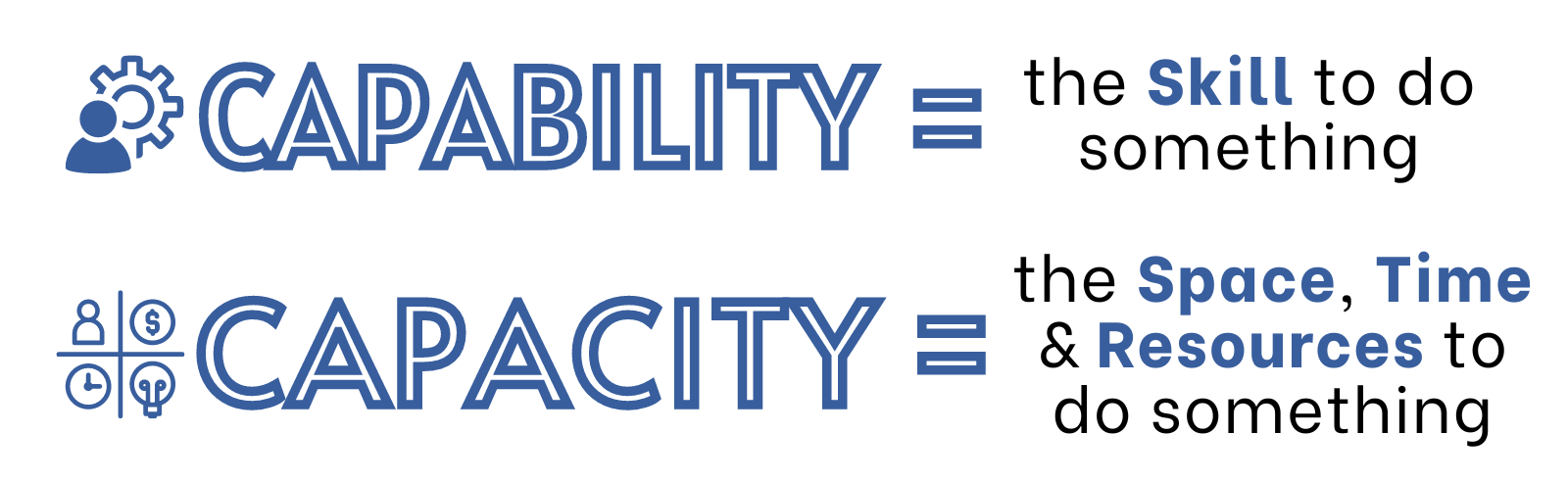
Bonita Nuttall makes a really important distinction between Capability and Capacity.

They are clearly related. If we have a higher level of Capability, we are more likely to be efficient and effective, which positively impacts Capacity. But if we are already filled to Capacity, there’s no room to exercise capability.

Ineffective Concern

What are you concerned about? There are probably a few things that it is wise to keep an eye on and plan for. That’s not the same as worrying or fretting about them. As with many aspects of life, it’s simple, but not necessarily easy.

I try to limit concern to factors that will have a direct impact on me, and that I have little control over. With today's Reserve Bank announcement further raising the interest rate in Australia, this is definitely a legitimate concern for many of us. We can’t directly change the interest rate, but we can pre-consider its implications and our potential actions. It’s prudent to keep an eye on it, because it will have an effect.

Ineffective concern would be worrying, ruminating , or losing sleep over it. Ineffective concern would also be ignoring it.

The best tactic to reduce worry is to run some realistic scenarios as a mental exercise. Consider their impact on you. Scenario planning is not about predicting the future. It’s about seeing alternative courses of action.

Are there any current elements in your environment you are ignoring but should be paying some attention to?

Are there any that you are burning time and energy worrying about instead of exploring options and potential actions?

Get after those… It can be scary to take the lid off the box, but it’s liberating to have a clear picture of implications, then face them square on.

Starts, Slog, Summit

Mount Kinabalu Summit

I climbed Mt Kinabalu in East Malaysia a number of years ago. There were parallels with every big undertaking I have experienced. Maybe you’ll see some links to professional and personal undertakings too.

There’s several starts I reckon. The idea of Kinabalu came from a magazine article and then a conversation with a friend who had done the climb. The first start is dreaming about it, rolling the possibility around in your mind. You imagine what it will be like. There’s no commitment yet, but there is attraction and excitement about the idea.

Start 2 is deciding to go for it. It unleashes a bunch of energy for planning and logistics. There’s action toward the climb although the mountain is still far away.

The point of psychological no return is another start. It normally happens some way into the actual climb. It’s a moment when you realise there’s no turning back. It’s very different from the decision to do it. I usually encounter doubt at this threshold - Have I got what it takes? Why am I doing this? What if I fail? These thoughts and more cause a spike of stress. (More on that another time). Once ‘no return’ is accepted, it feels like commitment increases and I’m all in. For leaders, not that this moment usually occurs at different times and for different reasons for the individuals that make up a team. Recognising the moment, and supporting people as they cross the threshold is a massive piece in creating alignment for significant projects.

At the beginning there is an abundance of energy. You can see the summit, and the reasons for climbing have not yet been tested by the hard work it takes to do it. Kinabalu has over 20000 rough steps built or carved into the rock. At some point you lose sight of the summit, and start to notice the thinning air. It’s a slog. In places you can see less than 100 metres ahead. I took to tackling 10 steps at a time. Small, achievable bites. It felt endless. It would be easy to turn back or lose hope at this point. Maybe you’ve noticed that moment in a big professional undertaking - losing sight of the end, and maybe the reason you set out in the first place, you struggle to take the next step. Bite size it, push on, remind yourself (and others) of why.

Eventually you break through the jungle and cloud and see the summit again. At this stage there’s still work ahead, but you know you'll make it. Eventually you stand at the pinnacle, enjoy the view and start thinking about what’s next. Celebrate those moments. You earned it!

Effective Action

We were 5 days into a serious desert survival exercise. We had run short of water because we had assumed that the springs we saw in the first few days would continue. Up until that moment, no one had really spoken candidly. As with any team in the early stages of coming together, we were inclined to defer, accommodate and agree. That all changed when someone suggested a 7km backtrack to the last large body of clean water we had seen. Given our 20km daily target, this would have almost doubled our work rate for the day, and added risk. We were standing beside a small flowing stream, but it was smelly and had algae covering the water.

The effort of the suggested backtrack flipped the group into a candid conversation about the effort, reward, risks and other factors involved in the decision. While the conversation was difficult, our decision to filter and boil the lower quality water and keep moving forward was a good one. We all focused on the problem, rather than the people. Suggestions were made and debated vigorously.

In a workplace this is one of the key benefits of psychological safety. Candid conversations get us to better decisions, less unnecessary effort, less do-overs, less frustration. It’s commercially astute.

On top of creating the environment for frank conversations, there also has to be effective action. The two most common reasons people have for not speaking up:

  • Fear - looking stupid, ridicule, losing your job, retaliation, retribution or isolation have people weighing whether it’s worth the risk.

  • Nothing Changes - If people do speak up, but nothing changes, it feels pointless and people will stop doing it.

Candour in our survival group required action on both fronts. People’s input was welcome and respected (after all, we would all have to live with the consequences of the final decision). Once discussed, a firm decision was made and the group immediately took action.

Which of these 2 reasons for not speaking up is more prevalent in your workplace? Why? What could you do personally and today to move forward?

Like a Lighthouse

My mate Jeremy Watkins reckons we have the wrong idea of clarity in leadership. People commonly think of clear glass or water when picturing clarity. Jeremy says a lighthouse in heavy fog is a more useful concept. The lighthouse can't help you see in the fog, but it can show the way and mark the rocks. Good leaders do that by distilling purpose and challenges down to a few clear pieces that their teams can action.

In a recent workshop with senior leaders I saw this in action. We generated a large page of current challenges. Some impact their whole sector, some unique to their organisation. It was a lot. The page was overwhelming. But they can't afford to ignore any of it. Every item is mission critical in some way. Ignorance, far from being bliss, could spell ruin.

One leader had a lighthouse moment. “This all boils down to 4 themes”, she said. She nailed it! The page didn't change but there was a palpable sense of relief and clarity about what they needed to do about it. That clarity will flow on to the whole organisation. It's much easier to make and communicate a clear plan for 4 themes than it is for the 100 plus items on the original page.

Could your organisation benefit from clarity like that? In what areas? What would the impact be of achieving it? How will you create the time and space to reach it? It’s unlikely to emerge from the fog on its own. Be the lighthouse.

Testing...testing

Small tweaks ideally happen all the time. Those changes to systems, approaches and thinking that come from observing ourselves, peers and competition in relation to our work. But sometimes a big change is required… David Lloyd George, Prime Minister of Britain during WWI said, “Don’t be afraid to take a large step where one is indicated. You can't cross a chasm in two small leaps.” I love the imagery that evokes!


Small changes can be a fantastic practice ground for bigger steps. Great leaders use the smaller moments to create a sense of safety to suggest or make changes. They can become like mini dress rehearsals for:

  • Being open to and encouraging of new ideas

  • Robust discussion about the merits of new ideas

  • A cadence of testing stuff to see if it has merit

When a big step is needed, this practice may well be what makes the difference.